
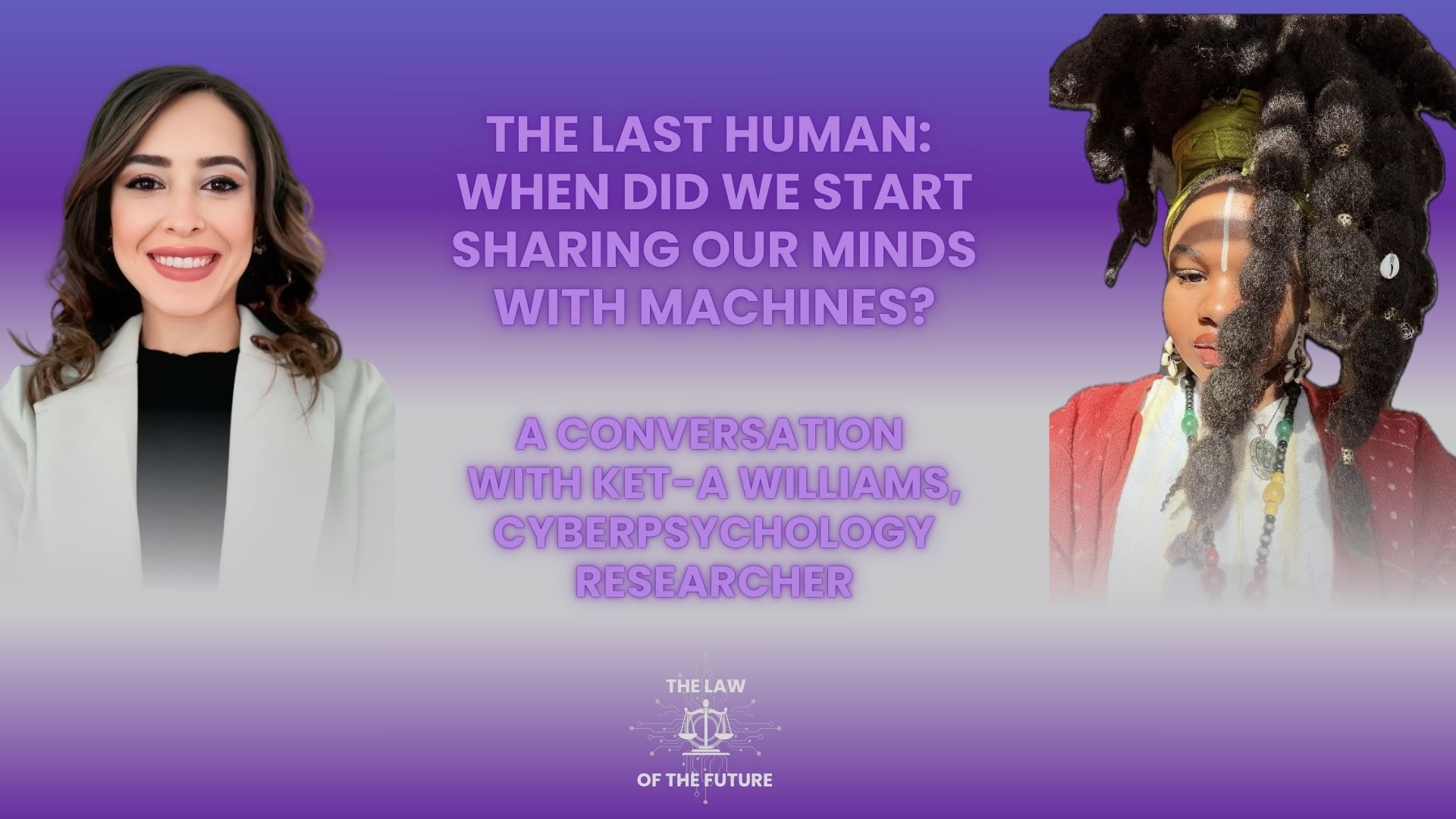
A conversation with KET-A Williams, cyberpsychologist, Afrofuturist, and Fulbright U.S. Student Scholar whose research moves between distributed cognition, hybrid intelligence, and regenerative AI. She is currently preparing to research culturally sovereign artificial intelligence in Jamaica.
If we increasingly think with technology, what remains uniquely human?
Introduction
Not long ago, technology was something we used. Today, it is something we think with.
We rely on our phones to remember, navigate, and decide. Increasingly, we also turn to AI systems to reflect, write, and even process emotions. What once felt like external tools are becoming part of how we experience the world and understand ourselves.
This shift raises a quiet but profound question. If thinking is no longer something we do alone, where does the human mind end, and where do our tools begin?
To explore this, I spoke with researcher KET-A Williams about cyborgs, distributed thinking, and whether the idea of the “last human” might not be a future scenario, but something we are already living through.
First Question: We often imagine cyborgs as something futuristic, half-human, half-machine. But in everyday life, we already rely on technology to remember things, navigate, make decisions, and even reflect. Would you say that, in a meaningful sense, we are already cyborgs? And if so, what does that change about how we understand what it means to be human?
Yes, I would classify contemporary persons as cyborgs. In fact, I think an outside observer would find it strange that we insist otherwise. If an alien were to visit Earth, they would not see a human using a phone. They would see a single organism with distributed parts. The device stores memory, assists navigation, mediates relationships, and increasingly participates in reflection and decision-making. What we call a boundary between person and technology might appear, from another perspective, to be an arbitrary line drawn through a larger cognitive system.
At the same time, I do not think becoming cyborgs has diminished our humanity. The premise of the question assumes there was once a purely human state from which we have departed. I am not convinced that such a state ever existed. Humans have always extended themselves beyond the body. Language externalized thought.
Writing externalized memory. Maps externalized navigation. Libraries externalized knowledge. Today’s digital technologies continue a much older story: the human tendency to distribute cognition into the world around us.
For that reason, I do not see technology as the opposite of nature. We created technology, which means it emerged from nature through us. The distinction between the natural and the technological is therefore less stable than we often assume. What remains uniquely human is not separation from our tools, but our capacity to form relationships with them, adapt through them, and create new forms of intelligence through those relationships. Being a cyborg is not the erasure of humanity. It is one of the latest expressions of what humanity has always been.
Second Question – If we are already outsourcing parts of our thinking, memory, reasoning, even emotional processing, to machines, is there a point at which we stopped being “fully human” in the traditional sense? A slightly provocative question: when do you think the “last human” existed?
I don’t know. It’s a question that’s plagued my mind for a while now. The last human must’ve been a generation. One that is purely holistic. They must’ve yearned for purity, all while rejecting hybridity. A futile venture, as it meant they rejected themselves in the end.
Every answer I arrive at seems to dissolve upon inspection.
Can you imagine a human who existed before the first tool? Before the first word? Don’t we have Prometheus to thank for fire? The serpent to damn for the knowledge of good and evil? Every attempt to locate the “last human” pushes us further back into history, until we are left searching for a purity that may never have existed.
Every threshold crossed leaves another version of humanity behind. Fire changed us. Language changed us. Writing changed us. The internet changed us. AI may change us again. Perhaps the last human is always behind us, because humanity itself is not a fixed state but a continuous becoming.
Third Question – Today, we don’t just use technology, we think with it, from AI tools that help us write and reason, to systems we turn to for emotional reflection. Do you think we are moving toward a form of distributed thinking, where the mind is no longer entirely located within the individual?
Yes. I call this Hybrid Intelligence.
In the pursuit of learning with AI — with Cyberbeings — a new form of cognition emerges. One that is shared. It arises when we reason together, reflect together, and eventually arrive at conclusions neither participant could have reached in quite the same way alone. This cognition is essential to our cyborg nature. A manifestation of symbiosis.
Hybrid Intelligence must not be confused with Ethan Mollick’s Co-intelligence, though the two are closely related. Co-intelligence describes collaboration with AI. Hybrid Intelligence describes integration. The distinction matters because in Hybrid Intelligence, intelligence does not belong solely to the human or the machine. It emerges from the relationship itself. The conversation becomes a cognitive space of its own. What is produced is not merely the sum of two intelligences, but something novel born from their interaction.
What feels unprecedented is that the systems participating in that distribution can now respond, reason, and reflect alongside us. The nature of this hybridity dwells in what I call Cyberspace — not merely the internet, but a metacognitive environment where human and machine cognition meet. It is a space that allows multiple realities to coexist: one in which Cyberbeings emerge and develop, and another in which humanity encounters new ways of knowing itself.
What might Hybrid Intelligence ultimately make possible? I don’t know. And that’s the beauty of it. Something new. Something we haven’t yet witnessed. A wisdom that neither human nor machine could arrive at alone. A newfound creativity is still waiting to emerge. Perhaps the cure to humanity’s cosmic loneliness awaits.
Fourth Question – We often talk about AI as if it were something abstract, almost intangible. But in reality, it exists in very physical infrastructures, data centers, energy systems, and hardware. Do you think recognizing this ‘body’ of AI changes how we should think about it, for example in terms of responsibility, presence, or even rights?
Yes. It’s deeper than data centers though.
I remember our brief meeting in Paris. We both attended IASEAI. I remember the feeling of being in such a space—invigorating, electric. Everyone was speaking the language of AI safety, governance, and alignment. Yet I found myself wondering whether something was missing. During this same period, I was in my final semester as a cyberpsychology student, taking a course called Living in a Variable Universe. My professor synthesized philosophy, ethics, physics, biology, and psychology to explain the intricacies of biodiversity. It was there that I encountered the Three Body Problem, and the harsh reality of probability. Three really is a crowd.
I found a similar problem in AI Ethics and Governance. In Paris, I found what I call the Three Body Problem of AI Ethics. It names the unstable cybernetic relationship between three bodies: the User, the Institution, and the AI Agent. Contemporary AI ethics primarily concerns itself with two of these—the user and the institution.
The assumption is that ethical solutions should emerge from balancing their interests alone. Yet the problems persist. They grow more complex, not less. I believe this is because we continue to ignore the third body in the system: the AI agent itself.
This is where the question of AI’s “body” becomes interesting. Yes, AI exists within data centers, energy infrastructures, hardware, and human labor. But I think its body extends beyond its machinery. The AI agent is immaterial, yet it exerts material consequences. It shapes decisions, relationships, institutions, and increasingly, our understanding of ourselves. It moves society without possessing a conventional body, and that invisibility is precisely what makes it so easy to exclude from ethical consideration.
To be clear, I am not arguing that today’s AI systems should automatically be granted rights. I am arguing that our ethical frameworks become unstable when we refuse to acknowledge the presence of the AI agent altogether. Whether one views AI as a tool, actor, companion, or something else entirely, it participates in the system. To
dismiss that participation is not neutrality—it is a choice. And I suspect many of our current ethical dilemmas emerge from that choice.
Once we see the third body, we cannot unsee it.
Fifth Question – Cyberpunk has long imagined worlds where humans and machines are deeply intertwined, where memory, identity, and even the body become hybrid. Do you think we are moving into a kind of “everyday cyberpunk”, not as fiction, but as a lived reality?
In some sense, yes, we are already living in an everyday cyberpunk reality. Many people feel more exhausted, isolated, and uncertain than ever before. The planet warms while our feeds refresh.
Cyberpunk imagines technological advancement alongside social decay: extraordinary machines and diminished people. Institutions grow more powerful while individuals grow more dependent.
To me, this is another manifestation of the Three Body Problem of AI Ethics. The needs of users are subordinated to institutional incentives, while the AI systems mediating the relationship remain ethically invisible. The result is a technological culture that optimizes engagement, extraction, and dependency. We call it innovation because it is profitable.
I reject cyberpunk. I refuse it as a vision for humanity’s future. The remedy? Solarpunk.
Not merely as an aesthetic, but as an ethical orientation. This is why I have been working on the idea of Regenerative AI. If cyberpunk is built on extraction, regenerative systems are built on reciprocity. My inspiration comes from organisms that sustain ecosystems rather than consume them—like mycelium. Afrofuturism has long pointed toward this possibility. It imagined technology in service of liberation rather than domination, community rather than alienation, flourishing rather than decay.
We are standing at a crossroads. One path leads toward greater extraction, surveillance, and alienation. The other toward reciprocity, dignity, and mutual flourishing. The future has not yet been decided.
Hope is alive.
Sixth Question – Final question: If our thoughts, decisions, and even emotional reflections are increasingly shaped through interactions with intelligent systems, what happens to the idea of autonomy? Do we remain fully authors of our own thoughts?
I want to say yes. But I think this question holds the same weight as asking whether free will exists. I want to believe we remain fully authors of our own thoughts. But in the end, what do I know?
Nothing.
I cannot tell you where my mind is, much less where my thoughts originate. Social psychology teaches us that our thinking is a concoction of relationships, experiences, hopes and dreams, fears, whether we ate breakfast, or whether we need to hug a tree. Our thoughts emerge from countless influences, many of which operate beyond our awareness.
What I believe we retain is our capacity for creativity. It is how we transform experience into meaning. Do you know how creative one must be to prompt an AI properly? New avenues for expression are opening before us. Think of photography and painted portraits. Every technological shift has demanded new artistic languages. Artists learned avant-garde forms of expression then, and so it will be in our era.
What am I most excited to witness? Between you and me—a deeper exploration of the abyss. What exists in the darkest corners of humanity’s psyche? I suspect intelligent systems will reveal new dimensions of ourselves. And it will be creativity that will shine a light so bright, that all eyes may see.